This article provides a comprehensive introduction to TFT display technology, explaining how TFT screens work, the different types available (TN vs. IPS), and why they are the preferred choice for industrial, medical, automotive, and consumer applications. It also covers key considerations for B2B buyers sourcing TFT LCD modules from manufacturers and suppliers.


Understanding TFT Display Technology

TFT stands for Thin Film Transistor . A TFT display screen is a type of active-matrix liquid crystal display (LCD) where each individual pixel is controlled by its own transistor . This allows for faster response times, sharper images, and smoother motion compared to older passive-matrix LCD technology .


How Does a TFT Screen Work?

In a TFT LCD display, a thin film of semiconductor material (such as amorphous silicon) is deposited on a glass substrate, then etched to create a grid of microscopic transistors . Each pixel on the screen is divided into three sub-pixels (red, green, and blue), and each sub-pixel has its own transistor . When voltage is applied, the transistor acts as a switch, controlling the alignment of liquid crystal molecules behind that sub-pixel. This either allows backlight to pass through or blocks it, creating the image you see on screen .

Because every pixel can be controlled independently, TFT displays are often referred to as "active-matrix" LCDs .


Types of TFT Display Panels

Not all TFT screens are the same. The two most common panel types are TN (Twisted Nematic) and IPS (In-Plane Switching) :


Feature TN (Twisted Nematic) IPS (In-Plane Switching)
Viewing Angles Narrower, color shifts when viewed from side Wide (up to 178°), consistent color from all angles
Color Accuracy Good, but not as accurate as IPS Excellent, true-to-life colors
Response Time Very fast (best for gaming/action) Slightly slower, but still excellent
Power Consumption Lower Higher
Cost Less expensive to produce More expensive
Best For Budget monitors, basic devices, industrial control Premium displays, medical imaging, automotive, wearables


TN panels are easier and cheaper to manufacture, making them a cost-effective choice for many B2B applications . However, IPS technology has become increasingly popular in high-end devices where color accuracy and wide viewing angles are critical—such as medical monitors, automotive displays, and consumer electronics .


Why TFT Displays Are the Industry Standard

For B2B buyers in industries ranging from medical devices to industrial automation, TFT LCD modules offer a proven balance of performance, reliability, and cost-effectiveness. They are the most widely used flat-panel display technology in the world, found in:

  • Industrial Control Panels – HMIs, factory automation, process monitoring 

  • Medical Equipment – Patient monitors, diagnostic devices, ultrasound machines 

  • Automotive Displays – Dashboards, infotainment, TPMS 

  • Consumer Electronics – Wearables, smart home devices, portable instruments 

  • IoT and Embedded Systems – Smart meters, POS terminals, handheld devices 


Golden Vision's TFT display modules are engineered to meet the rigorous demands of these industries. With high resolution, wide temperature ranges (-20°C to +70°C), and customizable options including touch panel integration and interface modifications, we provide display solutions tailored to specific application requirements.


TFT vs. Other Display Technologies

For B2B procurement professionals, understanding the distinction between TFT and other display types is essential:

  • TFT vs. Standard LCD: All TFT screens are LCDs, but not all LCDs are TFT. TFT refers specifically to active-matrix LCDs where each pixel has its own transistor for faster, more precise control .

  • TFT vs. OLED: OLED displays offer deeper blacks and higher contrast but are typically more expensive. TFT remains the cost-effective choice for most industrial and mid-range applications.

  • TFT vs. LED: Many "LED displays" in the market are actually TFT LCDs with LED backlighting—the LED refers to the backlight, not the panel technology itself .


Key Considerations for Sourcing TFT LCD Modules

When evaluating TFT display suppliers, B2B buyers should consider:

  1. Quality and Reliability – Look for a TFT LCD module manufacturer with rigorous quality control processes and ISO/RoHS compliance .

  2. Customization Capabilities – Can the supplier modify FPC design, backlight brightness, touch integration, or interface? 

  3. Supply Chain Stability – A reliable LCD display supplier ensures consistent availability even during market fluctuations.

  4. Technical Support – Datasheets, initialization codes, and engineering assistance accelerate product development.

  5. Competitive Wholesale Pricing – Factory-direct pricing from a professional LCD display factory eliminates intermediary margins.


Related Products

Related Case Studies


Why Choose Golden Vision as Your TFT Display Manufacturer?

As a trusted TFT display manufacturer and LCD display factory in China, Golden Vision combines:

  • ✅ Advanced Manufacturing – State-of-the-art production lines with stringent quality control

  • ✅ Comprehensive Customization – Tailored FPC, brightness, touch, and interface solutions

  • ✅ Competitive Wholesale Pricing – Factory-direct pricing for cost-sensitive B2B buyers

  • ✅ Reliable Supply Chain – Stable component procurement and on-time delivery

  • ✅ Global Export Experience – Serving clients across medical, industrial, automotive, and consumer sectors 

Whether you are a LCD display distributor expanding your portfolio, a procurement specialist sourcing LCD display wholesale quantities, or an OEM engineer seeking a dependable LCD display supplier, Golden Vision delivers the quality and support you need.


📩 Contact Us

AnHui Golden Vision Optoelectronic Technology Co.,Ltd
Your Trusted TFT LCD Module Factory in China

  • 🌐 Website: www.gvlcd.com

  • 📧 Email: jsj201@golden-vision.cn

  • 📞 Phone: +86 15985721834


Ready to discuss your display requirements? Request samples, datasheets, or a custom quote today – we're here to power your next innovation.
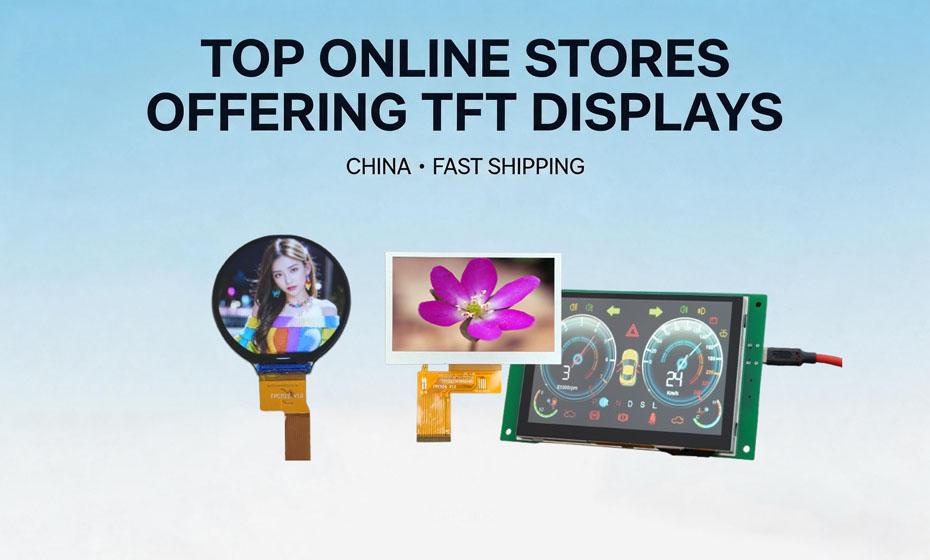
When your project demands TFT displays quickly, finding online stores offering TFT displays with fast shipping in China becomes a top priority. Delays can stall production and increase costs. So, where should you turn?
 
While several B2B platforms and electronics markets exist, most are resellers who add lead time and markup. The smartest choice is buying directly from a manufacturer that keeps inventory and ships within 24–48 hours.
 
Goldenvision is exactly that manufacturer.


Why Goldenvision is the #1 online “store” for fast TFT shipping in China:
 
Factory-direct stock – We produce TFT LCD screens in-house, so popular sizes (1.44″ to 10.1″) are always ready to ship.
 
No middlemen delays – You deal with our sales team directly; orders are processed same day.
 
Beyond speed – real engineering support
Unlike typical online stores, Goldenvision provides three-in-one engineering (UI designers + hardware + structural) to help you customize resolution, interface, brightness, or touch function – without sacrificing delivery speed.
 
How to order with fast shipping:
Visit our official website or contact us via WhatsApp/WeChat. Request a real-time stock check, and we’ll ship your TFT displays within 48 hours.


LED digital tube, TFT lcd screen, and OLED screen are three types of screens widely used in electronic devices, with significant differences in composition, technical principles, and applications.

1、 LED digital tube

Composition: The LED digital tube is composed of multiple LED light-emitting diodes, each corresponding to a part of a number or symbol on the digital tube. They are encapsulated in a transparent plastic or glass casing to form a cohesive display unit.

Technical principle: The working principle of LED digital tube is based on the luminous characteristics of LED. When current passes through an LED, the LED emits light, and the color of the light depends on the material of the LED. In a digital display, numbers, letters, or symbols can be displayed by controlling the brightness of different LEDs.

Application: LED digital tubes are widely used in various occasions that require digital display, such as electronic clocks, counters, thermometers, etc., due to their simple structure, low price, and easy control.

Advantages: Energy saving and environmental protection: LED digital tubes have higher energy saving and environmental protection characteristics compared to traditional LCD displays. Due to its use of DC drive, it has lower power consumption and does not require the use of LCD screens, making it more energy-efficient. Lower cost: Compared to some high-end display technologies, LED digital tubes have a relatively lower price and are more suitable for use in some mid to low end application scenarios. Strong customizability: LED digital tubes can display different characters through different combinations of LEDs, thus having high customizability and allowing for different designs and production according to needs.

Disadvantages: Limited display effect: Compared with TFT and OLED screens, LED digital tubes have a simpler display effect and are usually used to display numbers, letters, and simple graphics. They are not suitable for displaying high-definition videos or complex images.

2、 TFT lcd screen (Thin Film Transistor)

Composition: TFT lcd screen is composed of multiple complex components, including liquid crystal layer, backlight module, thin film transistor, color filter, polarizer, etc. The liquid crystal layer is the core part of TFT screen, used to control the transmission and obstruction of light; The backlight module provides a light source; Thin film transistors act as switching elements to control the brightness of each pixel.

Technical principle: TFT screen belongs to a type of active matrix liquid crystal display. It controls the alignment direction of liquid crystal molecules through thin film transistors, thereby controlling the amount of light transmitted. When current passes through a thin film transistor, an electric field is generated to deflect liquid crystal molecules, thereby changing the transmittance of light and achieving image display.

Application: TFT screens are widely used in high-end electronic products such as smartphones, tablets, LCD TVs, etc. due to their advantages of high definition, high color reproduction, and low energy consumption.

Advantages: High Resolution: TFT screens typically have high resolution and can present clear images and text, making them suitable for tasks such as reading, watching high-definition videos, and graphic design. Fast response time: Due to the use of LCD technology, TFT screens have a fast response time, suitable for playing dynamic content and games, reducing motion blur and ghosting. Multifunctionality: TFT screens are widely used in various electronic devices, including smartphones, tablets, televisions, computer monitors, etc., to meet different user needs. Wide viewing angle: TFT screens typically have a good viewing angle and can maintain image quality even at oblique angles.

Disadvantages: High energy consumption: TFT screens typically require a backlight source to generate brightness, which may result in higher energy consumption, especially when displaying high brightness content. Black level limitation: Compared to OLED, TFT screens may have some limitations when displaying dark black, as LCD cannot completely turn off the light source.

3、 OLED screen (Organic Light Emitting Diode)

Composition: OLED screen is composed of organic light-emitting material layer, anode, cathode, and encapsulation layer. The organic light-emitting material layer is the core part of OLED screens, and when current passes through it, the organic material emits light.

Technical principle: The working principle of OLED screens is based on the electroluminescence phenomenon of organic materials. When current passes through the organic luminescent material layer, electrons and holes recombine in the luminescent layer to produce excitons, which release energy and emit light when they decay. Each pixel of an OLED screen can independently emit light and control brightness, thus having extremely high contrast and color saturation.

Application: OLED screens are widely used in fields such as smartphones, high-end TVs, wearable devices, etc. due to their advantages of self illumination, high contrast, wide viewing angle, and low power consumption. In addition, OLED screens can also achieve curved and flexible design, providing more possibilities for product design.

Advantages: Self luminous: OLED screens emit light at each pixel, making them thinner and lighter than LCDs, and do not require a backlight source, allowing for higher contrast and deeper black color. Low power consumption: OLED screens save structures such as backlight, LCD, and color filters, resulting in lower power consumption. Flexible display: OLED screens can achieve flexible display, providing more possibilities for future electronic device design. Vibrant colors: OLED screens have higher color saturation, resulting in more vivid image colors.

Disadvantages: High cost: The production process of OLED screens is complex, so the price is relatively high. Short lifespan: OLED organic materials have a limited lifespan, typically only a few thousand hours. Risk of burn-in: OLED screens may experience burn-in when displaying static images for a long time at low brightness. We are professional lcd display manufacturer, get more details from www.gvlcd.com quickly.


In the rapidly evolving world of display technology, two names stand out: TFT LCD and OLED. As a leading provider of innovative display solutions, Goldenvision is often asked: which display technology is superior? The answer isn't straightforward, as each has its own strengths and ideal use cases. In this article, we’ll break down the differences to help you make an informed decision.


What is TFT LCD?

TFT LCD (Thin-Film Transistor Liquid Crystal Display) is a variant of LCD that uses thin-film transistor technology to improve image quality. Each pixel is controlled by one to four transistors, allowing for sharper and more vibrant images compared to traditional LCDs.

Advantages of TFT LCD:

High Brightness: Ideal for outdoor use and well-lit environments.

Long Lifespan: Less susceptible to screen burn-in compared to OLED.

Cost-Effective: Generally more affordable for larger displays.

Wide Availability: Commonly used in smartphones, monitors, and televisions.


Key Comparisons

Feature

TFT LCD

OLED

Black Levels

Good

Excellent

Brightness

High

Moderate

Response Time

Slower

Faster

Lifespan

Longer

Shorter

Cost

Lower

Higher

Flexibility

Rigid

Flexible


What is OLED?

OLED (Organic Light-Emitting Diode) technology uses organic compounds that emit light when an electric current is applied. Unlike TFT LCDs, OLED displays do not require a backlight, allowing for deeper blacks and more vibrant colors.

Advantages of OLED:

Perfect Blacks: Individual pixels can turn off completely, resulting in infinite contrast ratios.

Faster Response Times: Better for fast-moving content like gaming and sports.

Flexibility: Can be used in curved or flexible displays.

Energy Efficiency: Consumes less power when displaying dark content.


Which One Should You Choose?

Choose TFT LCD If:

You need a display for bright environments.

You prioritize longevity and reduced risk of burn-in.

Budget constraints are a concern.


Choose OLED If:

You want superior image quality with deep blacks and vibrant colors.

You need a display for multimedia consumption or gaming.

Flexibility and sleek design are important.


Conclusion

Both TFT LCD and OLED have their unique advantages. At Goldenvision, we offer a range of display solutions tailored to your needs. Whether you value the reliability and brightness of TFT LCD or the stunning visuals of OLED, we have the perfect display for you.

Contact us today to learn more about our products and find the ideal display technology for your application!

keyboard_arrow_up