Magnetic cores are vital components in electronics, essential for efficient energy conversion in transformers, inductors, and chokes. The right core material significantly impacts a device's performance, efficiency, size, and cost. This article compares two key materials: traditional ferrite cores and advanced nanocrystalline cores.
1. What Are Ferrite and Nanocrystalline Cores?
Understanding their basic structure is key to their properties.
Ferrite Cores: The Established Workhorse
Ferrite cores are dense ceramic structures made primarily from iron oxide (Fe2O3) mixed with other metal oxides like manganese, zinc, nickel, or magnesium. These mixtures are shaped and fired at high temperatures (around 1300°C). Their high electrical resistivity minimizes eddy current losses, making them ideal for low-frequency applications. Ferrites offer design flexibility and can be molded into various shapes, including U-cores low power allpications. MnZn ferrites are typically used below 5 MHz, while NiZn ferrites suit 0.01MHz up to 20MHz.
Nanocrystalline Cores: The High-Performance Innovator
Nanocrystalline cores are advanced soft magnetic materials with exceptionally small grain sizes, typically 10 to 20 nanometers.Their metallic alloy composition is mainly iron (Fe) with additions of silicon (Si), boron (B), niobium (Nb), and copper (Cu).They are manufactured by rapidly solidifying molten metal into an amorphous ribbon, then precisely heat-treating it to induce nano-crystallization.This nanoscale structure results in remarkably low core loss, low magnetostriction, high saturation induction, and very high initial permeability,over 80Kμm at 10KHz and over 20Kμm at 100KHz.They also exhibit excellent thermal stability from -40 to 120 degree celsius.
2. Ferrite vs. Nanocrystalline: A Performance Showdown
Nanocrystalline materials generally outperform ferrite cores in critical magnetic properties, though ferrite retains specific advantages.
Advantage of Nanocrystalline Core
Nanocrystalline cores offer significant performance benefits:
Permeability: Nanocrystalline materials have significantly higher permeability, often ten times that of ferrite cores.This allows for smaller, more efficient components with fewer turns.
Saturation Flux Density (Bs): Nanocrystalline cores boast a much higher saturation flux density (1.2 T to 1.32 T) compared to ferrite cores (around 0.3 T to 0.49 T for MnZn ferrite).This means they can handle stronger magnetic fields without saturating, enabling more powerful designs.
Core Loss: A major advantage of nanocrystalline core is their significantly lower core losses across a wide frequency range. This leads to enhanced energy efficiency, less heat generation, and simpler thermal management.
Frequency Response: Nanocrystalline cores offer a broadband frequency range and maintain properties at very high frequencies, such as 20MHz in transformers, due to vanishingly low magnetostriction.
Thermal Stability: Nanocrystalline cores show superior thermal stability, with stable core loss from -40°C to 140°C and a high Curie temperature around 570°C. Ferrite core loss can vary more with temperature.
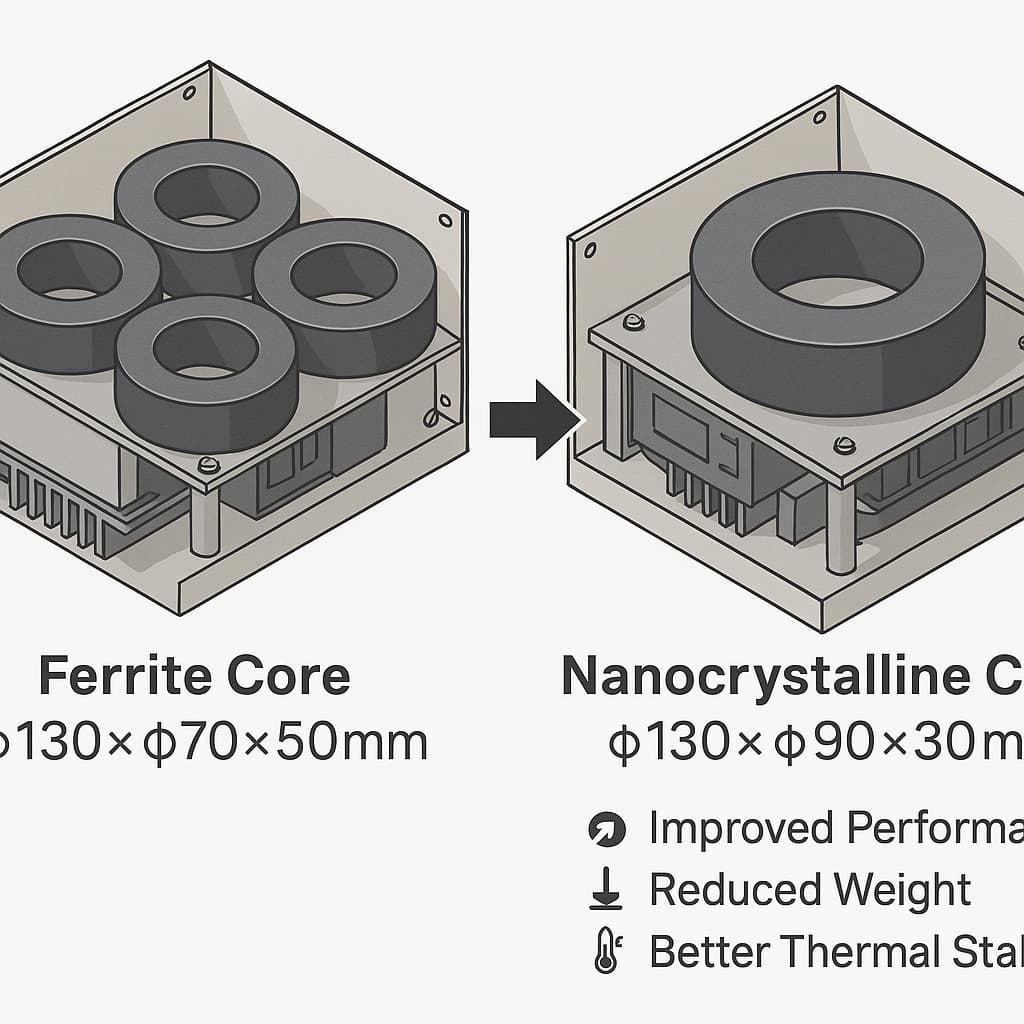
Size & Weight: The superior magnetic properties of nanocrystalline cores enable smaller and lighter components, leading to higher power density (e.g., up to 12 W/cm³ compared to 6 W/cm³ for ferrite transformers).This is crucial for miniaturization.
Where Ferrite Remains a Strong Choice & Considerations
Despite nanocrystalline's superior performance, ferrite cores remain relevant:
Cost-Effectiveness: Ferrite cores are generally more economical and easier to produce.While nanocrystalline cores offer higher performance, they typically have a higher upfront cost.
Specific Application Suitability: For simpler EMI noise scenarios with low energy or single frequencies, inexpensive ferrite cores are often sufficient and more cost-effective.
High Permeability Challenge: The extremely high permeability of nanocrystalline cores can sometimes lead to saturation issues in specific toroidal core designs, where a ferrite material with low permeability might be more effective.
Table 1: Ferrite vs. Nanocrystalline Core Comparison
|
Property
|
Ferrite Core
|
Nanocrystalline Core
|
|
Composition
|
Ceramic (Iron Oxide + Mn/Zn/Ni/Mg oxides)
|
Metallic Alloy (Fe, Si, B, Nb, Cu)
|
|
Typical Grain Size
|
Micrometers
|
Nanometer range (10-20 nm)
|
|
Permeability (µ)
|
Lower (e.g., 5000+ for MnZn)
|
Very High (e.g., 20,000 – 200,000µ)
|
|
Saturation Flux Density (Bs)
|
Lower (e.g., 0.3-0.49 T)
|
Higher (e.g., 1.2-1.25 T)
|
|
Core Loss (relative)
|
Higher
|
Very Low (e.g., 1000x reduction vs SiFe)
|
|
Frequency Range
|
Up to 20KHz (MnZn <5MHz)
|
Broadband (up to 20MHz for
|
|
Thermal Stability
|
Less stable (loss varies with temperature)
|
Excellent (stable -40°C to 140°C, high Curie ~570°C)
|
|
Typical Cost (relative)
|
Lower
|
Higher
|
|
Size Implication
|
Larger components
|
Smaller/Lighter components
|