You need the best enterprise hard drives in 2026 to scale massive server infrastructure efficiently. High-density cloud storage environments require proven drives like the Seagate Exos X series, Western Digital Gold, and Toshiba MG Series. These enterprise hard drives handle intense continuous workloads in your data center.
Your procurement strategy must evaluate critical metrics beyond upfront cost-per-terabyte. You should match drive workload ratings to your system requirements while choosing SAS or SATA interface options for each server chassis. Modern high-capacity mechanical hard disk drives ensure operational reliability during continuous year-round performance. Selecting the right hardware protects your scalable storage investment.
Key Takeaways
-
Select high-capacity drives like Seagate Exos or WD Gold to scale your data center efficiently.
-
Match SAS or SATA drive interfaces to your specific server chassis and workload requirements.
-
Combine high-speed solid-state drives with mechanical hard drives to create a balanced tiered storage system.
-
Helium-sealed drive designs reduce internal gas friction and lower overall power consumption by fifty percent.
Best Enterprise Hard Drives for 2026
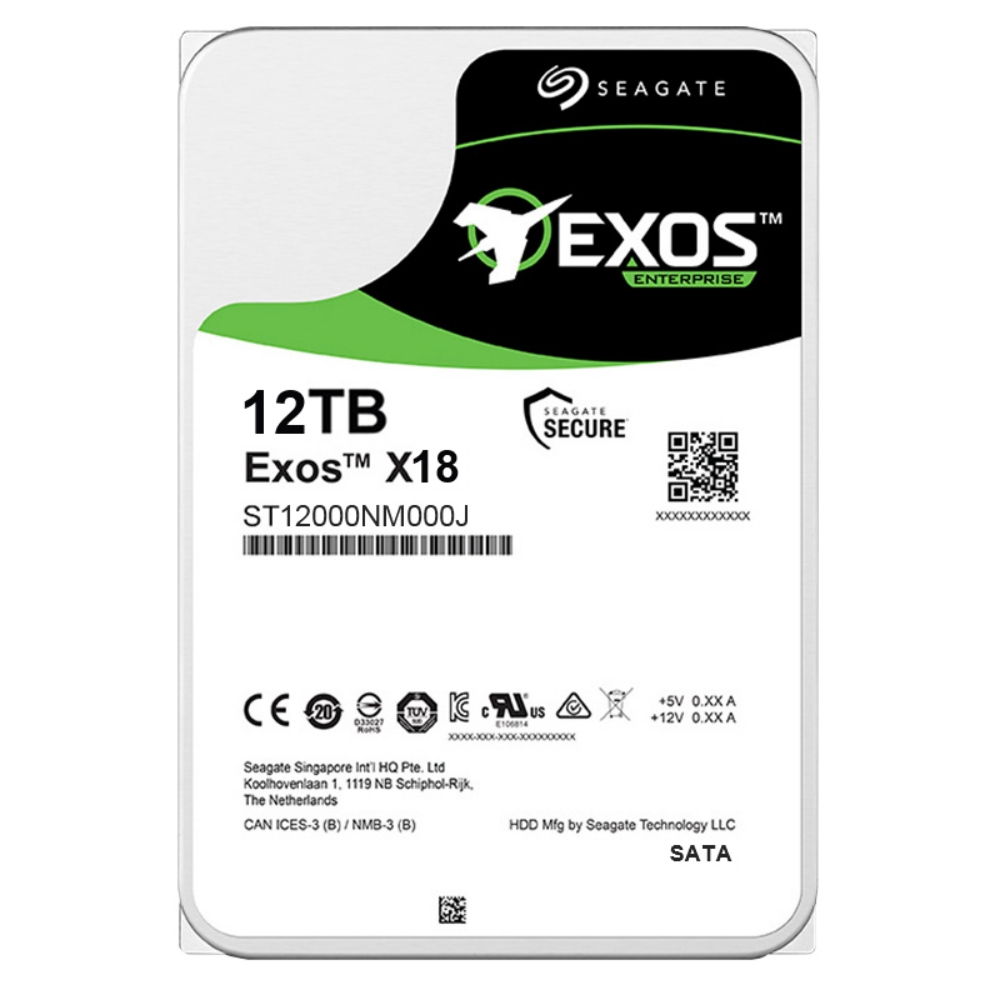
You need the best enterprise hard drives to manage growing operational volumes across your infrastructure. Selecting high-capacity enterprise storage hard drives allows your data center to achieve peak efficiency. Modern server chassis rely on specialized drives built for heavy continuous workloads.
Top Drives for Mass Data Density
Leading manufacturers offer exceptional server hdd options designed for demanding rack environments. Seagate delivers maximum server hdd capacities through its Mozaic 3+ HAMR platform, reaching 32TB with the Exos M ST32000NM000K drive. You can also deploy the Seagate Exos M ST30000NM004K at 30TB SATA or the Exos X24 ST24000NM007H at 24TB SAS.
Western Digital expands enterprise hard drives options with the WD Gold 26TB drive, which utilizes ePMR and OptiNAND technologies. Meanwhile, Toshiba provides the MG11 series at 24TB using FC-MAMR technology and a 1GB cache. The table below compares these top models across key server hdd specifications:
|
Model |
Capacity |
Interface |
Workload Rating |
Spin Rate |
|---|---|---|---|---|
|
Seagate Exos M ST32000NM000K |
32TB |
SATA 6Gb/s |
550 TB/year |
7200 RPM |
|
Seagate Exos M ST30000NM004K |
30TB |
SATA 6Gb/s |
550 TB/year |
7200 RPM |
|
WD Gold 26TB |
26TB |
SATA 6Gb/s |
550 TB/year |
7200 RPM |
|
Toshiba MG11 |
24TB |
SATA 6Gb/s |
550 TB/year |
7200 RPM |
Each enterprise hdd option includes critical enterprise features like rotational vibration protection and 5-year warranties. These enterprise features ensure system stability when you install dozens of drives inside a single server enclosure.
Performance Comparison of Leading Models
Evaluating mechanical hdd speed helps you match each server hdd to your operational workload. Read and write speeds vary across technologies, as shown in manufacturer tests and independent evaluations:
|
Drive Model |
Rated Speed |
Independent Sequential Read |
Independent Sequential Write |
|---|---|---|---|
|
Seagate Exos M 30TB |
275 MB/s |
292 MB/s |
289 MB/s |
|
Western Digital Gold 26TB |
288 MiB/s (~302 MB/s) |
283–285 MB/s |
Not reported |
|
Toshiba MG11 24TB |
295 MiB/s (~309 MB/s) |
Limited data |
Not reported |
Sequential throughput represents only one aspect of overall drive performance. You must also evaluate random access IOPS when configuring a server for mixed cloud storage applications. Standard mechanical units deliver moderate random IOPS compared to enterprise-grade SSDs for data centers. However, high-density server hdd drives remain essential for cost-effective bulk retention.
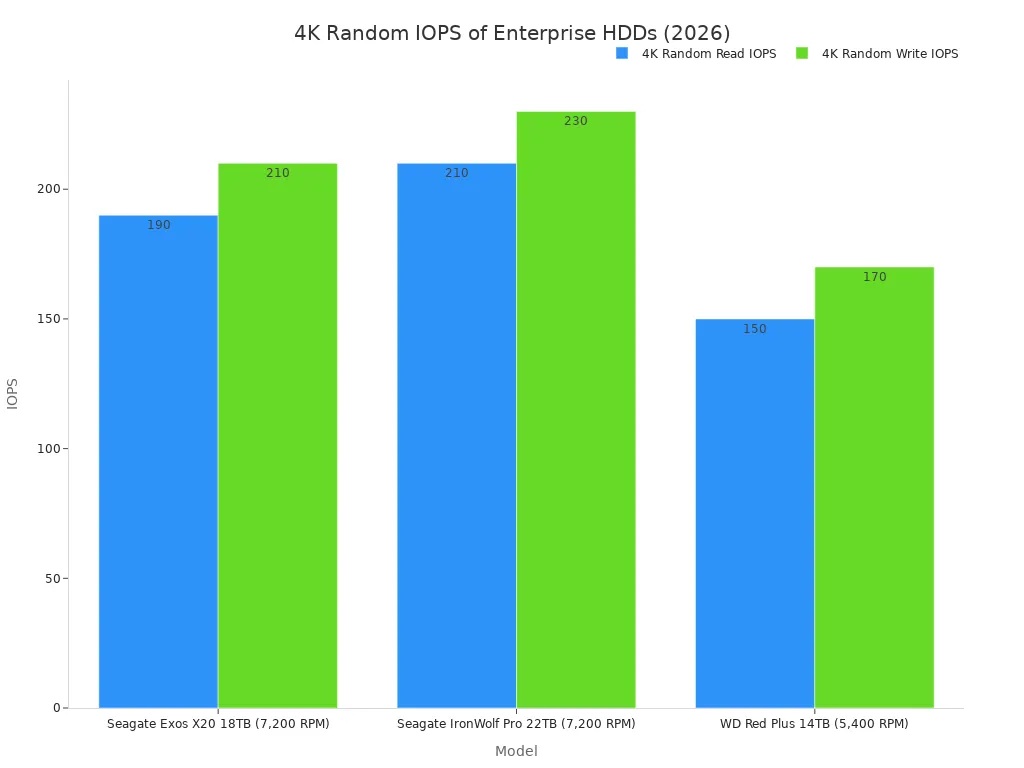
As the chart illustrates, the 7,200 RPM Seagate IronWolf Pro 22TB reaches ~210 4K random read IOPS and ~230 4K random write IOPS. The Seagate Exos X20 18TB achieves ~190 4K random read IOPS and ~210 4K random write IOPS. The 5,400 RPM WD Red Plus 14TB trails with ~150 4K random read IOPS and ~170 4K random write IOPS.
Integrating high-performance server hdd units alongside ssd cache tiers creates balanced storage architectures. Advanced enterprise features such as thermal throttling control drive health across dense racks. Furthermore, hardware encryption enterprise features safeguard sensitive data across active server deployments. Choosing the best enterprise hard drives ensures scalable capacity, long-term endurance, and consistent throughput for your enterprise hard drives fleet.
Key Selection Criteria for Enterprise Hard Drives
You must evaluate critical technical factors before purchasing high-capacity enterprise storage hard drives for your storage array. Selecting the correct drive architecture prevents system bottlenecks and maximizes physical density.
Capacity, Interface, and Rotational Speed
Interface selection defines overall system topology and drive communication speed. Enterprise infrastructure relies primarily on Serial Attached SCSI (SAS) and Serial ATA (SATA) protocols.
A SAS controller or backplane accepts SATA drives, but a SATA controller will never accept a SAS drive.
This hardware design rule governs connection matching across every rack enclosure. A dual-port SAS enterprise hdd provides multi-path redundancy for mission-critical operations, whereas SATA offers cost-effective connections for bulk data. You should select enterprise-grade SSDs for data centers when your workloads demand sub-millisecond access times. However, mechanical drives deliver superior cost-per-terabyte storage efficiency. Spindle rotational speed directly impacts access latency and sequential throughput, as outlined in the following table:
|
Spindle Speed |
Class |
Strengths |
Best For |
|---|---|---|---|
|
7,200 RPM |
Midline / nearline (3.5") |
Highest capacity, lowest cost per TB, low power |
Backups, archives, bulk cold storage |
|
10,000 RPM |
Enterprise (2.5") |
Balance of speed, capacity, density |
General-purpose and moderate-performance workloads |
|
15,000 RPM |
Performance enterprise (2.5") |
Lowest HDD latency, highest HDD IOPS |
Legacy performance needs |