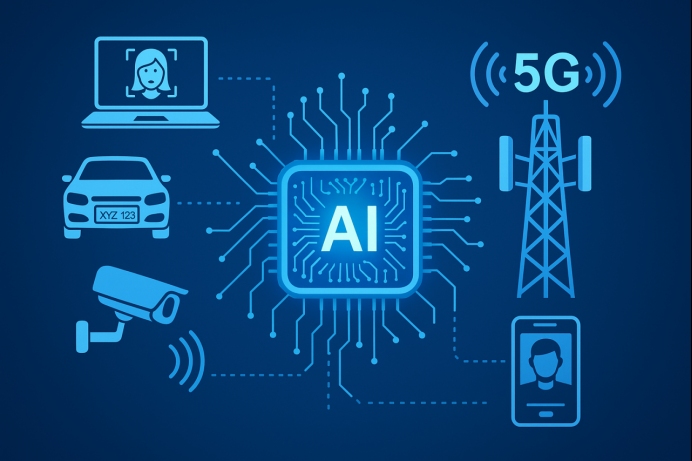
The convergence of Artificial Intelligence (AI) and 5G technology is fundamentally reshaping the digital landscape. Together, they enable an era of real-time data processing, ultra-fast connectivity, and intelligent decision-making. From high-definition video transmission to large-scale edge computing and AI inference, this combination is driving breakthroughs in smart cities, autonomous systems, and industrial automation. At the heart of these systems lies a critical yet often overlooked component—the crystal oscillator—which ensures precise frequency stability and synchronization across all connected devices.
The Role of Crystal Oscillators in High-Definition Video Transmission
With 5G’s ultra-low latency and AI-powered compression algorithms, high-definition (HD) and even 8K video streaming are becoming standard in surveillance, broadcasting, and telemedicine. In these applications, data transmission speed and synchronization are paramount. Crystal oscillators provide the stable clock reference that ensures seamless data flow and frame accuracy.
In video backhaul systems, even a small deviation in timing can result in jitter, frame drops, or audio desynchronization. A high-precision temperature-compensated crystal oscillator (TCXO) or voltage-controlled crystal oscillator (VCXO) maintains signal stability despite environmental fluctuations. This is especially crucial in outdoor or mobile environments, where temperature and vibration can affect frequency accuracy. As AI algorithms enhance video clarity and analytics, oscillators ensure that every pixel and frame is transmitted with perfect timing.
Real-Time Recognition: AI at the Edge
Real-time facial and license plate recognition systems are becoming core components of intelligent transportation and security networks. These systems rely on edge AI processors that analyze massive data streams within milliseconds. However, edge devices must maintain strict timing synchronization to ensure accuracy in recognition and identification.
In these environments, low-jitter crystal oscillators play a pivotal role in coordinating AI inference tasks. They provide the precise clock signals required by processors, image sensors, and wireless modules. For instance, in smart intersections or access control systems, timing accuracy determines whether recognition results are correctly matched to vehicles or individuals. Without stable oscillation, even advanced AI algorithms can yield inconsistent outputs.
By enabling synchronized operation between 5G modules and AI chips, oscillators support deterministic latency and reliable data flow—key factors for real-time decision-making.
Large-Scale Device Connectivity: AI + 5G + Edge Computing
The growth of IoT ecosystems under 5G has led to massive device interconnections—from industrial sensors and robots to smart home systems. Each of these nodes requires precise frequency references to maintain reliable communication. Crystal oscillators ensure that devices remain synchronized across networks, reducing packet loss and enhancing efficiency in multi-device coordination.
Edge computing further amplifies this need. AI inference at the edge reduces data transmission to centralized servers, minimizing latency and bandwidth usage. However, distributed AI networks depend on consistent timing to merge and process data from thousands of sources simultaneously. High-frequency oscillators with excellent phase noise performance provide the necessary synchronization backbone for these distributed AI systems.
In industrial IoT (IIoT) environments, where 5G connects machines, robots, and control systems, oscillators ensure stable operation across fluctuating voltages, vibrations, and electromagnetic interference. This reliability supports predictive maintenance, process automation, and energy optimization—all made possible through the interplay of 5G and AI.
The Foundation of Intelligent Edge Systems
As networks evolve toward AI-driven edge intelligence, timing precision becomes a key enabler. Smart edge nodes that process data locally depend on oscillators to coordinate between sensors, processors, and communication modules. In autonomous vehicles, drones, and robotic systems, microsecond-level synchronization determines operational safety and accuracy.
Crystal oscillators—particularly OCXOs (Oven-Controlled Crystal Oscillators)—offer ultra-high stability suitable for mission-critical timing. They form the foundation of synchronization frameworks in edge AI architectures, ensuring that decisions are based on accurate, time-aligned data.
In 5G base stations, oscillators maintain synchronization across antennas for beamforming and MIMO operations. Meanwhile, AI algorithms optimize power allocation and signal routing in real time. Together, they achieve higher throughput, lower latency, and more efficient resource utilization.
Looking Ahead: A Unified AI + 5G Ecosystem
As AI models grow more complex and 5G networks expand globally, the demand for precise timing solutions will continue to rise. Crystal oscillators—though small in size—are indispensable to ensuring the integrity and synchronization of high-speed, intelligent systems.
The future of connectivity lies in AI-enhanced, 5G-enabled ecosystems, where every device, camera, and sensor operates in perfect harmony. From smart manufacturing to intelligent surveillance, from autonomous transport to telemedicine, stable frequency control remains the invisible force behind reliability and performance.If you need to purchase crystal oscillators, please contact us at ivy@jghcrystal.com and we will provide you with the most professional solutions.