In RF passive networks, a power splitter may look simple, but choosing the wrong type can directly impact system stability, coverage balance, and long-term reliability.
Below, we take three representative models as engineering cases—a 350–2700 MHz 50W Wilkinson splitter, a 698–7125 MHz cavity splitter, and a 450–512 MHz UHF 4-way Wilkinson splitter—to break down how to select the correct product for your project.
1. What Defines a “Good” Power Splitter?
A high-quality splitter must do more than divide energy.
For engineering applications, the following indicators usually determine whether a splitter is suitable for long-term deployment:
-
Stable phase and amplitude balance across the operating band
-
Low insertion loss, which helps maximize system efficiency
-
Excellent port isolation, reducing intermodulation risks
-
High power endurance, especially for outdoor or base-station scenarios
-
Mechanical robustness, ensuring stable performance in harsh environments
Every application scenario places different emphasis on these indicators.
Below, we use real product cases to illustrate how to evaluate a splitter based on bandwidth, structure, and operation environment.
2. 350–2700 MHz 50W 2-Way Wilkinson Power Splitter — Broad-Band and Stable
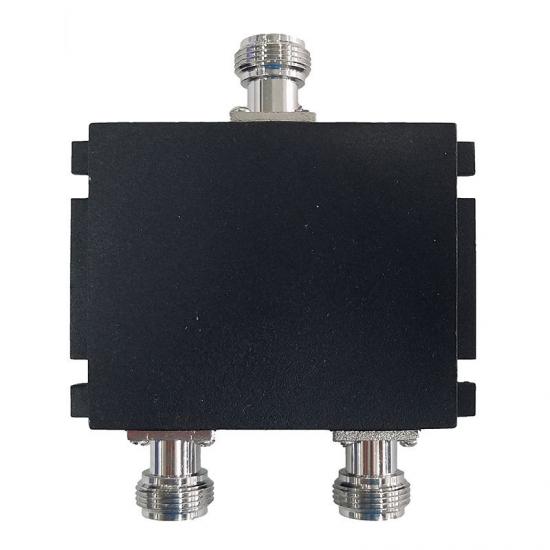
This model covers 350–2700 MHz, making it suitable for multi-system environments where a single device must handle several bands—such as public safety networks, trunking systems, 4G/5G co-siting, and repeaters.
Key Advantages
-
Ultra-wide bandwidth, compatible with multiple RATs in one network
-
Wilkinson architecture, delivering good phase consistency and low loss
-
50W power rating, sufficient for most indoor/outdoor distributed systems
-
Compact metal housing, easy for wall-mounting or cabinet integration
Recommended Use Cases
-
Multi-band DAS
-
Emergency communication systems
-
Urban in-building coverage
-
Multi-operator shared sites
3. 698–7125 MHz 2-Way Cavity Power Splitter — Best for High-Frequency 5G
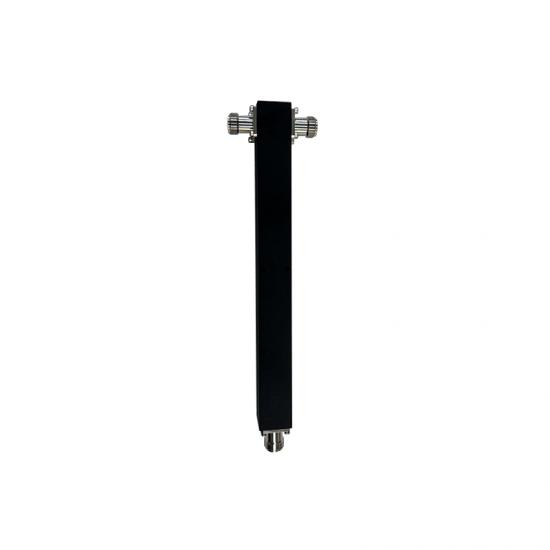
When entering higher-frequency 5G deployment (3.5 GHz, 4.8 GHz, up to 7 GHz), Wilkinson structures become limited.
For this range, cavity splitters offer significantly better linearity, stability, and power handling.
Why Engineers Choose Cavity Splitters
-
Superior heat dissipation and high power endurance
-
Very low passive intermodulation (PIM)
-
High mechanical stability, suitable for rooftop and tower-top use
-
Excellent isolation even across wide high-band frequencies
Typical Applications
-
3.3–4.9 GHz 5G private networks
-
High-band 5G small cell systems
-
Large venues requiring stable high-capacity coverage
-
High-power outdoor base stations
For any system involving 3.5 GHz and above, cavity structures offer the most dependable long-term performance.
4. 450–512 MHz UHF 4-Way 50W Wilkinson Power Splitter — Optimized for Narrowband Public Safety
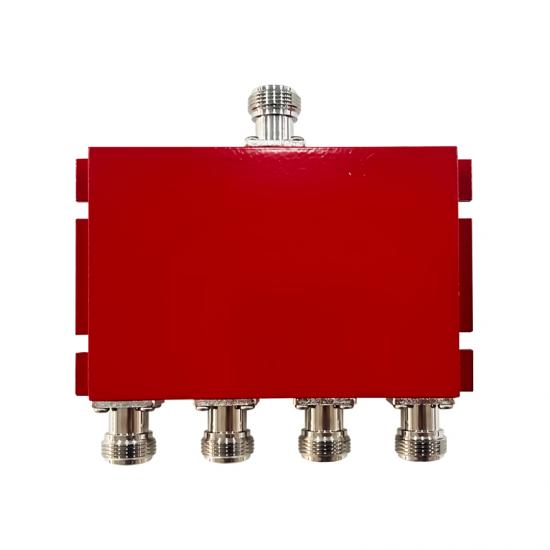
This model focuses on the UHF band (450–512 MHz), often used in:
-
Police and fire communication systems
-
Trunking networks
-
Industrial wireless networks
-
Mining and power-grid communication
Product Highlights
-
Classic Wilkinson circuit, maintaining excellent balance
-
4-way equal power distribution, suitable for multi-sector coverage
-
High reliability, supporting continuous 24/7 operation in security systems
-
50W power handling, meeting typical UHF repeater requirements
Engineering Scenarios
-
Distributed UHF repeater systems
-
Public safety base-station coverage extension
-
Industrial campuses and tunnels
-
Harsh outdoor environments
5. How to Choose Between Wilkinson, Cavity, and High-Power UHF Splitters
| Scenario / Requirement | Recommended Type | Reason |
|---|---|---|
| Multi-band 350–2700 MHz | Wilkinson | Wideband, cost-effective, excellent performance |
| High-frequency 698–7125 MHz (5G) | Cavity | Better linearity, stability, power handling |
| UHF 450–512 MHz public safety | Wilkinson | Strong isolation + high reliability |
| High-power outdoor environments | Cavity | Superior thermal / mechanical advantages |
| Low-PIM systems | Cavity or High-grade Wilkinson | Depends on frequency band |
6. Final Engineer’s Notes
When selecting an RF power splitter, price should not be the first parameter—system reliability, frequency match, and long-term performance matter far more.
-
Wilkinson = wideband, stable, cost-efficient
-
Cavity = high power, high stability, low PIM, best for high bands
-
UHF specialized splitters = optimized for narrowband and mission-critical communication
If you are building a DAS, upgrading a base station, or integrating multiple systems into one network, choosing the correct structure helps you avoid repeated maintenance and signal imbalance issues later.
If you need help selecting a model based on your project specs, I can generate a full engineering matching guide for you.