What Is Pixel Pitch And Screen Resolution?


1. LED Screen Pixel Pitch


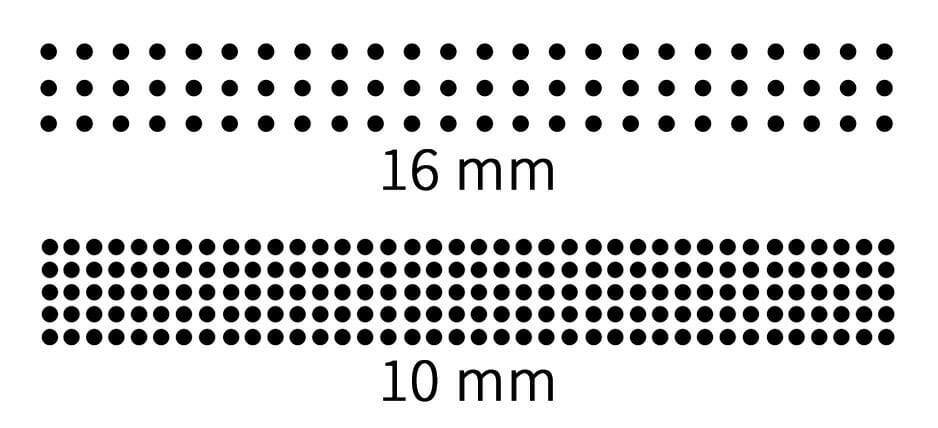
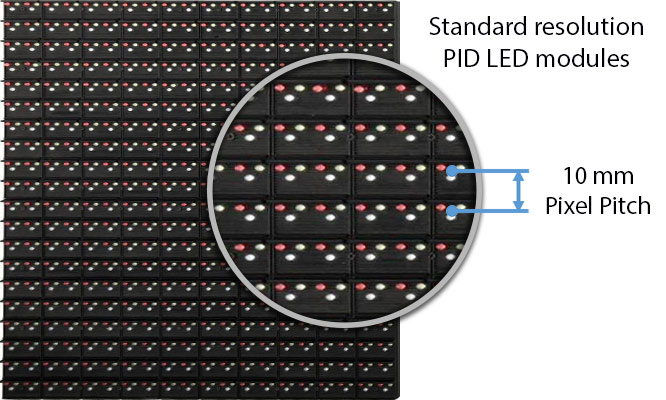
The distance between the LED screen diodes determines the resolution of the screen. From the center of each set of red, green, and blue diodes, the distance to the center of the adjacent group is measured. This distance is called the pixel pitch. Each set of diodes together form a pixel – or pixel.


If the LED screen has a pixel pitch of 1 cm, each pixel can have 100 x 100 pixels. Square screen. The resolution on the screen is set to the number of pixels in height and width. If your screen is 6 x 8 meters and the pixel spacing is 1 cm, the resolution is 600 x 800 pixels.


2. Image Resolution


Image resolution is the detail an image holds. The term applies to raster digital images, film images, and other types of images. Higher resolution means more image detail.


Resolution refers to the number of pixels in an image. Resolution is sometimes identified by the width and height of the image as well as the total number of pixels in the image. For example, an image that is 2048 pixels wide and 1536 pixels high (2048 x 1536) contains (multiply) 3,145,728 pixels (or 3.1 Megapixels).


Image resolution can be measured in various ways. Resolution quantifies how close lines can be to each other and still be visibly resolved. Resolution units can be tied to physical sizes , to the overall size of a picture, or to angular subtense.


The measure of how closely lines can be resolved in an image is called spatial resolution, and it depends on properties of the system creating the image, not just the pixel resolution in pixels per inch (ppi). In effect, spatial resolution refers to the number of independent pixel values per unit length. Get more details of small pixel pitch led screen from www.chipshow.com.


small pixel pitch led screen


Do you know what is Image Sticking?


If you remain a fixed image on LCD Display for a long period of time, you may experience a phenomenon called Image Sticking. Image Sticking - sometimes also called “image retention” or “ghosting”- is a phenomenon where a faint outline of a previously displayed image remains visible on the screen when the image is changed. It can occur at variable levels of intensity depending on the specific image makeup, as well as the amount of time the core image elements are allowed to remain unchanged on the screen. In POS applications, for example, a button menu which remains fixed, or in which the “frame” elements (core image) remain fixed and the buttons may change, may be susceptible to image sticking. It is important to note that if the screen is used exclusively for this application, the user may never notice this phenomenon since the screen never displays other content. `It is only when an image other than the “retained” image is shown on the screen that this issue becomes evident. Image sticking is different that the “burn-in” effect commonly associated with phosphor based devices.


What causes Image Sticking? 

Image sticking is an intrinsic behavior of LCD displays due to the susceptibility to polarization of the interior materials (liquid crystals) when used under static, charged conditions (continuously displaying the same image). The individual liquid crystals in an LCD panel have unique electrical properties. Displaying a fixed pattern - such as the POS menu described above – over prolonged periods can cause a parasitic charge build-up (polarization) within the liquid crystals which affects the crystals’ optical properties and ultimately prevents the liquid crystal from returning to its normal, relaxed state when the pattern is finally changed. This effect takes place at a cellular level within the LCD, and the effect can cause charged crystal alignment at the bottom or top of a crystal cell in the “z”axis, or even crystal migration to the edges of a cell, again based on their polarity. These conditions can cause image sticking over an entire area, or at boundaries of distinct color change respectively. In either case, when the liquid crystals in the pixels and sub-pixels utilized to display the static image are polarized such that they can not return fully to their “relaxed” state upon deactivation, the result is a faint, visible, retained image on the panel upon presentation of a new, different image. The actual rate of image retention depends on variation factors such as the specific image, how long it is displayed unchanged, the temperature within the panel and even the specific panel brand due to manufacturing differences among panel manufacturers.


How to Avoid Image Sticking?

- Try not to operate the LCD with a “fixed” image on the screen for more than 30 minutes.

- If you are operating the monitor in an elevated temperature environment and with a displayed image which is contrary to the recommendations in“For Software Developers”below, image stick can occur in as little as 30 minutes. Adjust your screen saver settings accordingly.  

1) Power down the unit during prolonged periods of inactivity such as the hours a store is closed or a shift during which the piece of equipment isn’t used.

2)Use a screensaver with a black or medium gray background that is automatically set to come on if the device is inactive for more than 5-10 minutes.

3)Avoid placing the monitor in poorly ventilated areas or in areas that will create excess heat around the monitor for software developers.

4)In defining the icons, buttons, or windows in the screen, try to utilize block patterns instead of distinct lines as borders for dividing the display into distinct areas.  

5) If it is necessary to display a static image, try to use colors that are symmetric to the middle gray level at the boundary of two different colors, and slightly shift the borders line once in a while.

6) Try to utilize medium gray hues for those areas that will have prolonged display times or remain static as other menu elements change.


How to Fix the Image Sticking?

Unlike the usually irreversible “burn-in” effects commonly associated with direct view phosphor display devices such as CRTs, an image retained on an LCD display can be reversed – often to a point of total invisibility. However, the severity of the underlying causes (as described above) of the image retained on a specific display, as well as the variation factors (see “For Software Developers” above) under which the retained image was created, will dictate the final level of retention reversal. One way to erase a retained image on a panel is to run the screen (monitor “on”) in an “all black” pattern for 4-6 hours. It is also helpful to do this in an elevated temperature environment of approximately 35º to 50ºC. Again, utilizing a dynamic screen saver with an all black background during prolonged idle display periods is a good way to avoid image retention issues.


Is Image Sticking Covered by TSD (Team Source Display) RMA Warranty?

Image sticking is a phenomenon inherent to LCD Display technology itself, and as such, the occurrence of this “ghosting” effect is considered normal operation by the manufacturers of the LCD display modules which are integrated into today’s monitor solutions. TSD does not warrant any display against the occurrence of image sticking. We strongly advise that you follow the operating recommendations listed above to avoid the occurrence of this phenomenon.


tslcd Reliability testing for Image Sticking: 

25, 60%RH/30 minutes.

Note: Switch the image to Grey 127 after displaying the 5*8 chess pattern for 30 minutes,the after image disappears within 10 minutes.


Maintaining consistent temperature and humidity levels is a cornerstone of quality assurance in industries such as manufacturing, research, and storage. These environmental factors, while often overlooked, can have far-reaching impacts on production outcomes, product longevity, and experimental accuracy. Advanced tools like temperature and humidity loggers, or sometimes with wireless data transferring functions like wireless data loggers have become indispensable for meeting the challenges of environmental monitoring in these contexts.

Effective environmental monitoring is not without its challenges. Addressing these requires not just the right tools but a deep understanding of the demands imposed by various applications.


Why Temperature and Humidity Monitoring Is Crucial?

Temperature and humidity are more than mere environmental parameters—they are critical factors influencing materials, processes, and the stability of products.


-Production Environments:

In pharmaceuticals and food processing, maintaining specific conditions is necessary to prevent contamination and ensure compliance with safety standards. Temperature and humidity loggers are critical for tracking these parameters throughout production.

In electronics, uncontrolled humidity can lead to condensation, corrosion, or electrostatic discharge, potentially damaging components. A reliable wireless data logger can provide real-time insights, enabling quick responses to changes.


-Research and Laboratories:

Experimental accuracy depends on stable environmental conditions. Variations in humidity or temperature can compromise results or invalidate data. Data loggers ensure these parameters are documented precisely, supporting reproducibility and compliance.

Sensitive equipment like microscopes or spectrometers often requires controlled surroundings to operate optimally.


-Storage and warehouse temperature humidity monitoring:

Products like vaccines, chemicals, and perishable foods are highly sensitive to environmental changes. Deviation from prescribed conditions can lead to spoilage, reduced efficacy, or outright waste. Wireless data loggers allow remote monitoring and real-time alerts for these critical storage environments.


Challenges in Temperature and Humidity Monitoring

1. Dynamic Environmental Factors

Fluctuations in weather, seasonal variations, and HVAC system inconsistencies can make it challenging to maintain a steady environment. Without constant monitoring, these changes can go unnoticed until they cause significant issues.


2. Large-Scale Facilities

Monitoring temperature and humidity across expansive areas like warehouses or production floors requires systems capable of covering wide spaces. Variability across different sections of a facility adds complexity.


3. Compliance with Regulations

Industries like pharmaceuticals and food production are governed by strict regulations that demand detailed records of environmental conditions. Failing to meet these standards can result in penalties, product recalls, or damage to reputation.


4. Data Management and Analysis

Collecting data is only part of the solution. Interpreting trends, identifying risks, and maintaining compliance records can overwhelm manual processes, necessitating automated solutions.


5. Real-Time Alerts and Rapid Response

Quick detection and response are essential to prevent losses. For example, a sudden spike in temperature during vaccine storage could render the entire batch unusable. Real-time alerts and immediate action plans are critical.


Requirements for Effective Environmental Monitoring

To address these challenges, temperature and humidity monitoring systems must meet several essential requirements:


1. High Accuracy and Reliability

Precision in measurement is non-negotiable. Even small inaccuracies can have significant consequences, particularly in regulated environments. Sensors and loggers must deliver consistent and trustworthy readings.


2. Comprehensive Coverage

For large facilities, systems need to monitor conditions across multiple zones. Wireless or networked solutions can bridge gaps and provide a holistic view of environmental conditions.


3. Ease of Use

User-friendly interfaces, intuitive setup, and accessible data management tools are vital for ensuring staff can operate the system effectively without extensive training.


4. Scalability

Monitoring needs often grow over time, whether due to expanded facilities, increased production, or stricter compliance requirements. Systems must be able to scale seamlessly to meet future demands.


5. Compliance Support

Devices and systems should align with industry standards, such as ISO 17025 or FDA regulations, and facilitate easy reporting for audits or inspections.


6. Durability

In environmental monitoring, durability often hinges on the battery life of zhicetemptech data loggers and sensors. Devices deployed in remote or hard-to-access areas, such as high-storage shelves, laboratory chambers, or expansive production floors, must operate autonomously for extended periods. Frequent battery replacements can disrupt operations, increase maintenance costs, and compromise data continuity. Advanced wireless data monitoring systems also integrate power-saving modes and battery health indicators, further improving their durability and effectiveness in demanding applications.


7. Data Integration and Automation

Modern monitoring systems should integrate with existing workflows and automation platforms, providing actionable insights, trend analysis, and real-time notifications when thresholds are exceeded.


Striking the Balance

Implementing an effective temperature and humidity monitoring system is not just about meeting current needs but also anticipating future challenges. Businesses must strike a balance between upfront costs, system capabilities, and long-term benefits, ensuring that their chosen solutions align with operational goals and industry demands.

By addressing the inherent challenges and adhering to rigorous requirements, organizations can ensure optimal environmental control, protect their investments, and maintain compliance with regulatory standards.
 

In today’s fast-paced industrial environment, reliable and efficient networking solutions are crucial for seamless operations. One such solution that has gained significant traction is the Industrial Power over Ethernet switch. But what exactly is an Industrial PoE switch, and why is it essential for modern industrial applications?


Understanding Industrial PoE Switches

An Industrial PoE switch is a robust networking device designed to operate in harsh industrial environments. It combines the functionality of a standard network switch with the ability to provide power to connected devices through the Ethernet cables. This dual functionality not only simplifies network setup but also enhances operational efficiency by reducing the need for separate power supplies for each connected device.


Industrial POE Switch


Key Features of Industrial PoE Switches

Rugged Design

Industrial PoE switches are built to withstand extreme temperatures, humidity, and vibrations. Their rugged design ensures reliable performance in challenging environments such as factories, outdoor installations, and transportation systems.


Power Over Ethernet (PoE)

The PoE feature allows the switch to transmit electrical power along with data over Ethernet cables. This eliminates the need for additional power cables, simplifying the installation of devices like IP cameras, wireless access points, and VoIP phones in industrial settings.


Enhanced Security

Industrial PoE switches often come with advanced security features to protect the network from unauthorized access and cyber threats. These features may include VLAN support, access control lists (ACLs), and encryption protocols.


Redundancy and Reliability

To ensure continuous operation, many Industrial PoE switches offer redundancy features such as dual power inputs, ring topology support, and failover mechanisms. These features minimize downtime and ensure that the network remains operational even in the event of a component failure.


Types of Industrial PoE Switches

Industrial PoE switches come in various configurations to meet different networking needs. Two common types are the 4 port Industrial PoE switch and the 8 port Industrial PoE switch.

Industrial PoE switches

4 Port Industrial PoE Switch

A 4 port Industrial PoE switch is ideal for smaller industrial networks or specific applications requiring a limited number of PoE-enabled devices. It offers a compact and cost-effective solution for connecting and powering up to four devices, making it suitable for small-scale installations or focused applications like security camera systems.


8 Port Industrial PoE Switch

For larger networks or applications requiring more connected devices, an 8 port Industrial PoE switch provides greater capacity. With the ability to connect and power up to eight devices, this switch is perfect for more extensive industrial setups such as manufacturing plants, large-scale surveillance systems, and complex automation networks.


Applications of Industrial PoE Switches

Industrial PoE switches find applications in various sectors due to their versatility and reliability:


Manufacturing

In manufacturing environments, Industrial PoE switches facilitate the seamless integration of automation systems, sensors, and IP cameras. They enable real-time data transmission and remote monitoring, enhancing production efficiency and safety.


Transportation

In the transportation sector, these switches are used to connect and power devices like surveillance cameras, passenger information systems, and wireless access points in trains, buses, and stations, ensuring smooth and secure operations.


Oil and Gas

The harsh environments of the oil and gas industry require networking equipment that can withstand extreme conditions. Industrial PoE switches provide reliable connectivity for monitoring and controlling drilling operations, pipeline management, and safety systems.


Smart Cities

As cities become smarter, the demand for robust networking solutions grows. Industrial PoE switches support the deployment of IoT devices, traffic management systems, and public safety cameras, contributing to efficient and secure urban infrastructures.


An benchu-group Industrial PoE switch is a critical component in modern industrial networks, offering a combination of data connectivity and power delivery in a single device. Whether you need a 4 port Industrial PoE switch for a small setup or an 8 port Industrial PoE switch for a more extensive network, these switches provide the reliability, security, and efficiency required for today’s industrial applications. By integrating Industrial PoE switches into your network, you can ensure seamless and efficient operations, even in the most challenging environments.


In today's rapidly evolving industrial landscape, reliable and high-performance display solutions are essential for ensuring operational efficiency and productivity.  (Goldenvision World Enterprise) specializes in providing cutting-edge TFT LCD displays that meet the rigorous demands of industrial applications. In this article, we explore the diverse applications of TFT LCD displays in industrial equipment and how they contribute to enhancing performance and functionality.


What Makes TFT LCD Displays Ideal for Industrial Applications?


TFT LCD (Thin-Film Transistor Liquid Crystal Display) technology offers several advantages that make it particularly well-suited for industrial environments:

  • Durability: Designed to withstand harsh conditions, including extreme temperatures, humidity, and vibrations.

  • High Brightness and Readability: Excellent visibility even in brightly lit or outdoor settings.

  • Long Lifespan: Reliable performance over extended periods, reducing the need for frequent replacements.

  • Customizability: Can be tailored to meet specific industrial requirements, including size, resolution, and interface compatibility.


Key Applications of TFT LCD Displays in Industrial Equipment


1. Human-Machine Interfaces (HMIs)

TFT LCD displays are widely used in HMIs to provide operators with intuitive and interactive control over machinery and processes. Their high resolution and responsiveness ensure seamless communication between humans and machines, enabling precise monitoring and adjustments.

2. Industrial Automation and Control Systems

In automated manufacturing environments, TFT LCD displays serve as critical components for visualizing data, controlling robotic systems, and managing production lines. Their ability to display real-time information helps optimize efficiency and reduce downtime.

3. Test and Measurement Equipment

From oscilloscopes to multimeters, TFT LCD displays are integral to test and measurement devices. They provide clear and accurate readings, making it easier for technicians to analyze data and troubleshoot issues.

4. Medical and Laboratory Equipment

In industrial settings related to healthcare and research, TFT LCD displays are used in devices such as diagnostic machines, analyzers, and monitoring systems. Their reliability and clarity ensure accurate results and enhance operational safety.

5. Transportation and Logistics

TFT LCD displays are employed in forklifts, warehouse management systems, and logistics tracking devices. Their rugged design ensures functionality in demanding environments, while their high brightness guarantees readability under various lighting conditions.

6. Energy and Power Management

In power distribution systems, renewable energy controls, and grid monitoring equipment, TFT LCD displays provide real-time data visualization and control capabilities. Their durability makes them ideal for both indoor and outdoor use.

7. Agricultural and Construction Machinery

From tractors to excavators, TFT LCD displays are used in agricultural and construction equipment to provide operators with vital information about machine performance, navigation, and task management.


Why Choose Golden World Enterprise for Industrial TFT LCD Displays?


At Gvlcd, we understand the unique challenges of industrial applications. Our TFT LCD displays are engineered to deliver:

  • Superior Performance: High brightness, wide temperature ranges, and robust construction.

  • Custom Solutions: Tailored displays to meet specific industrial needs.

  • Reliability: Long-lasting performance with minimal maintenance requirements.


Conclusion


TFT LCD displays play a pivotal role in enhancing the functionality and efficiency of industrial equipment across various sectors. Their durability, clarity, and adaptability make them an indispensable component in modern industrial applications.

Contact Golden World Enterprise today to learn more about our industrial TFT LCD display solutions and how they can empower your operations!


In the rapidly evolving automotive industry, display technology plays a crucial role in enhancing both driver experience and vehicle functionality. Golden World Enterprise specializes in providing high-quality TFT LCD displays tailored for automotive applications. In this article, we explore why TFT LCD displays are the preferred choice for automotive dashboards and center consoles, highlighting their advantages and real-world applications.


The Growing Importance of Displays in Modern Vehicles


Modern vehicles are increasingly equipped with advanced display systems that provide critical information, entertainment, and control features. From digital instrument clusters to touchscreen infotainment systems, displays have become central to the driving experience. Among the various display technologies available, TFT LCD stands out for its reliability, performance, and versatility.


Advantages of TFT LCD Displays in Automotive Applications


1. High Brightness and Readability

Automotive displays must be visible under various lighting conditions, including direct sunlight. TFT LCD displays offer high brightness levels (often exceeding 1000 nits), ensuring clear readability without glare or washout. This makes them ideal for dashboard instrument clusters and center consoles.

2. Wide Operating Temperature Range

Vehicles operate in diverse environments, from freezing winters to scorching summers. TFT LCD displays are designed to function reliably across a wide temperature range (-30°C to +85°C), ensuring consistent performance in extreme conditions.

3. Long Lifespan and Durability

Automotive displays need to withstand vibrations, shocks, and long hours of operation. TFT LCD technology boasts a long lifespan and robust construction, reducing the risk of failures and minimizing maintenance needs.

4. Excellent Color Reproduction

TFT LCD displays deliver vibrant colors and high contrast ratios, enhancing the visual appeal of digital dashboards and infotainment systems. This is particularly important for rendering maps, media interfaces, and safety alerts accurately.

5. Customizability and Flexibility

TFT LCD displays can be customized in terms of size, shape, resolution, and interface compatibility. This flexibility allows automotive manufacturers to integrate them seamlessly into various vehicle models and designs.

6. Cost-Effectiveness

Compared to alternative technologies like OLED, TFT LCD displays offer a more cost-effective solution without compromising on performance. This makes them an attractive choice for mass-produced vehicles.


Applications of TFT LCD Displays in Automotive Systems


1. Digital Instrument Clusters

TFT LCD displays are widely used in digital instrument clusters to replace traditional analog gauges. They provide drivers with customizable, high-resolution information such as speed, fuel levels, navigation prompts, and vehicle diagnostics.

2. Center Console Infotainment Systems

Modern infotainment systems rely on TFT LCD touchscreens to offer features like navigation, media playback, climate control, and connectivity options. Their responsiveness and clarity enhance the user experience.

3. Head-Up Displays (HUDs)

TFT LCD technology is also used in head-up displays, which project critical information onto the windshield. This allows drivers to access data without taking their eyes off the road, improving safety.

4. Rear-Seat Entertainment Displays

In luxury and family vehicles, TFT LCD displays are often integrated into rear seats to provide entertainment for passengers. Their durability and high-quality visuals make them ideal for this purpose.


Case Study: TFT LCD in Electric Vehicles (EVs)

Electric vehicles rely heavily on advanced display systems to monitor battery status, range, charging information, and energy consumption. TFT LCD displays are particularly suited for EVs due to their energy efficiency, reliability, and ability to display complex data clearly.


Why Choose Golden World Enterprise?


At Gvlcd, we pride ourselves on delivering TFT LCD displays that meet the stringent requirements of the automotive industry. Our products are tested for:

  • High Performance: Optimal brightness, contrast, and response times.

  • Durability: Resistance to temperature extremes, vibrations, and humidity.

  • Customization: Tailored solutions to fit specific automotive designs and functionalities.


Conclusion


TFT LCD displays have become the technology of choice for automotive applications due to their reliability, versatility, and cost-effectiveness. From digital dashboards to infotainment systems, they enhance both the functionality and aesthetics of modern vehicles.

Contact Golden World Enterprise today to learn more about our automotive TFT LCD display solutions and how they can elevate your vehicle designs!


In the world of electronics, precision timing is a non-negotiable requirement for everything from microcontrollers to sophisticated communication systems. At the heart of this timing is the crystal oscillator, a component that provides a stable clock signal. While the terms "crystal" and "crystal oscillator" are sometimes used interchangeably, they are two distinct entities. Understanding this fundamental difference is the first step to appreciating the wide-ranging applications and performance demands placed on these essential components.


The Core Distinction: Passive vs. Active Components

Simply put, a crystal is the passive component, while a crystal oscillator is the complete active electronic circuit.

  •       A crystal, or more accurately a quartz crystal resonator, is a small piece of natural or synthetic quartz cut to a specific shape. It is a passive device that exhibits the piezoelectric effect: when an electric field is applied, it vibrates at a very precise frequency. This resonance is the core principle of a stable clock signal, but by itself, a crystal cannot generate an oscillation. It needs external circuitry.
  •       A crystal oscillator is the complete module. It includes the quartz crystal resonator, along with an oscillator circuit (typically a simple amplifier and feedback loop) and a power supply connection. This integrated unit is what actively generates the stable, periodic clock signal. This ready-to-use component is what engineers drop onto a circuit board to provide the necessary timing.

The true significance of a crystal oscillator is not just its basic function but how its performance is tailored to specific, demanding applications, a contrast best seen in the world of unmanned aerial vehicles (UAVs).


Military vs. Civilian UAVs: A Tale of Precision and Reliability

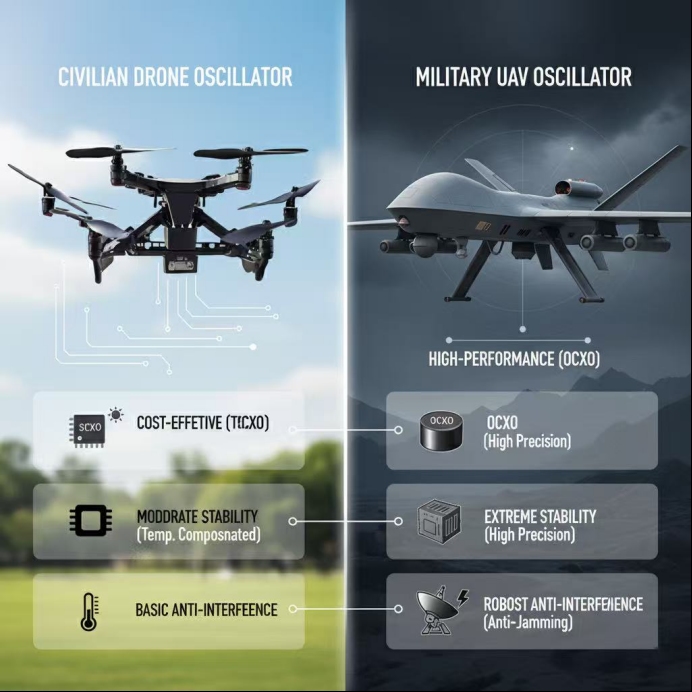
oscillator application in drones 

The choice of a crystal oscillator is a critical design decision that perfectly illustrates the stark differences between civilian drones and military UAVs. While both require a timing reference, their operational environments and mission objectives lead to vastly different component requirements.


Civilian drones, used for activities like aerial photography, package delivery, or agricultural monitoring, typically operate in less extreme conditions. Their design prioritizes a balance of cost, size, and efficiency. The crystal oscillators used in these devices are often standard, cost-effective models. While they provide adequate frequency stability for flight control and data communication, they are not designed for extreme temperatures or intense electronic warfare. Their robustness is sufficient for consumer use, making them a practical choice for a high-volume market.


In contrast, military UAVs are mission-critical systems. They must operate flawlessly in hostile and unpredictable environments, where failure can have severe consequences. These aircraft are subject to high G-forces during maneuvers, extreme temperature variations, and intentional signal jamming. This demanding environment necessitates an entirely different class of oscillators. Military-grade systems often employ high-performance, specialized crystal oscillators designed to maintain their timing precision under the most challenging conditions.


Performance Metrics: Stability, Temperature, and Anti-Interference

The difference in application directly translates to the performance metrics of the oscillator.

Frequency Stability

This metric is the most important differentiator. It measures how constant the oscillator's output frequency remains over time and under varying conditions. For civilian drones, a basic level of frequency stability is enough for their navigation and communication protocols. For military UAVs, which rely on secure and precise data links and GPS for mission success, an oscillator with superior stability is essential. Military systems often utilize OCXO (Oven-Controlled Crystal Oscillators), which actively maintain the crystal at a constant temperature to achieve an exceptionally high level of long-term stability. While more expensive and power-hungry, the precision they provide is non-negotiable for mission-critical systems.


Temperature Characteristics

Temperature is a major factor that affects the performance of any oscillator. Both crystal and crystal oscillator devices are susceptible to frequency shifts due to thermal changes. In a civilian drone, a TCXO (Temperature-Compensated Crystal Oscillator) is a common upgrade that uses an integrated circuit to correct for temperature-induced frequency drift, offering a good balance of cost and performance. Military applications, however, face a much wider thermal range, from frigid altitudes to desert heat. The temperature stability of the oscillator is paramount. OCXOs provide superior environmental resilience by completely isolating the crystal from ambient temperature fluctuations, ensuring consistent performance regardless of external conditions.


Anti-Interference Capabilities

In the digital age, electronic warfare is a serious threat. An oscillator's ability to resist external noise and interference is a key consideration. While a standard crystal oscillator is generally robust, it can still be affected by strong electromagnetic interference (EMI) or radio-frequency interference (RFI). Military-grade oscillators are designed with a focus on EMI immunity and enhanced shielding to protect the sensitive timing circuit from deliberate jamming or other electronic attacks. Their robust performance ensures that critical navigation and communication links remain functional even in a highly contested electromagnetic environment.


In summary, while a crystal and a crystal oscillator are fundamentally linked, it is the sophisticated engineering and application-specific design of the complete oscillator that truly matters. The choice between a consumer-grade oscillator and a military-grade one is a perfect example of how the environment and mission demands shape component selection, highlighting the crucial role of stability, resilience, and reliability in modern electronics.


LED digital tube, TFT lcd screen, and OLED screen are three types of screens widely used in electronic devices, with significant differences in composition, technical principles, and applications.

1、 LED digital tube

Composition: The LED digital tube is composed of multiple LED light-emitting diodes, each corresponding to a part of a number or symbol on the digital tube. They are encapsulated in a transparent plastic or glass casing to form a cohesive display unit.

Technical principle: The working principle of LED digital tube is based on the luminous characteristics of LED. When current passes through an LED, the LED emits light, and the color of the light depends on the material of the LED. In a digital display, numbers, letters, or symbols can be displayed by controlling the brightness of different LEDs.

Application: LED digital tubes are widely used in various occasions that require digital display, such as electronic clocks, counters, thermometers, etc., due to their simple structure, low price, and easy control.

Advantages: Energy saving and environmental protection: LED digital tubes have higher energy saving and environmental protection characteristics compared to traditional LCD displays. Due to its use of DC drive, it has lower power consumption and does not require the use of LCD screens, making it more energy-efficient. Lower cost: Compared to some high-end display technologies, LED digital tubes have a relatively lower price and are more suitable for use in some mid to low end application scenarios. Strong customizability: LED digital tubes can display different characters through different combinations of LEDs, thus having high customizability and allowing for different designs and production according to needs.

Disadvantages: Limited display effect: Compared with TFT and OLED screens, LED digital tubes have a simpler display effect and are usually used to display numbers, letters, and simple graphics. They are not suitable for displaying high-definition videos or complex images.

2、 TFT lcd screen (Thin Film Transistor)

Composition: TFT lcd screen is composed of multiple complex components, including liquid crystal layer, backlight module, thin film transistor, color filter, polarizer, etc. The liquid crystal layer is the core part of TFT screen, used to control the transmission and obstruction of light; The backlight module provides a light source; Thin film transistors act as switching elements to control the brightness of each pixel.

Technical principle: TFT screen belongs to a type of active matrix liquid crystal display. It controls the alignment direction of liquid crystal molecules through thin film transistors, thereby controlling the amount of light transmitted. When current passes through a thin film transistor, an electric field is generated to deflect liquid crystal molecules, thereby changing the transmittance of light and achieving image display.

Application: TFT screens are widely used in high-end electronic products such as smartphones, tablets, LCD TVs, etc. due to their advantages of high definition, high color reproduction, and low energy consumption.

Advantages: High Resolution: TFT screens typically have high resolution and can present clear images and text, making them suitable for tasks such as reading, watching high-definition videos, and graphic design. Fast response time: Due to the use of LCD technology, TFT screens have a fast response time, suitable for playing dynamic content and games, reducing motion blur and ghosting. Multifunctionality: TFT screens are widely used in various electronic devices, including smartphones, tablets, televisions, computer monitors, etc., to meet different user needs. Wide viewing angle: TFT screens typically have a good viewing angle and can maintain image quality even at oblique angles.

Disadvantages: High energy consumption: TFT screens typically require a backlight source to generate brightness, which may result in higher energy consumption, especially when displaying high brightness content. Black level limitation: Compared to OLED, TFT screens may have some limitations when displaying dark black, as LCD cannot completely turn off the light source.

3、 OLED screen (Organic Light Emitting Diode)

Composition: OLED screen is composed of organic light-emitting material layer, anode, cathode, and encapsulation layer. The organic light-emitting material layer is the core part of OLED screens, and when current passes through it, the organic material emits light.

Technical principle: The working principle of OLED screens is based on the electroluminescence phenomenon of organic materials. When current passes through the organic luminescent material layer, electrons and holes recombine in the luminescent layer to produce excitons, which release energy and emit light when they decay. Each pixel of an OLED screen can independently emit light and control brightness, thus having extremely high contrast and color saturation.

Application: OLED screens are widely used in fields such as smartphones, high-end TVs, wearable devices, etc. due to their advantages of self illumination, high contrast, wide viewing angle, and low power consumption. In addition, OLED screens can also achieve curved and flexible design, providing more possibilities for product design.

Advantages: Self luminous: OLED screens emit light at each pixel, making them thinner and lighter than LCDs, and do not require a backlight source, allowing for higher contrast and deeper black color. Low power consumption: OLED screens save structures such as backlight, LCD, and color filters, resulting in lower power consumption. Flexible display: OLED screens can achieve flexible display, providing more possibilities for future electronic device design. Vibrant colors: OLED screens have higher color saturation, resulting in more vivid image colors.

Disadvantages: High cost: The production process of OLED screens is complex, so the price is relatively high. Short lifespan: OLED organic materials have a limited lifespan, typically only a few thousand hours. Risk of burn-in: OLED screens may experience burn-in when displaying static images for a long time at low brightness. We are professional lcd display manufacturer, get more details from www.gvlcd.com quickly.


According to the latest report released by the globally renowned market research firm Omdia, the global shipment of LCD panels (9 inches and above) is expected to reach 875 million units by 2025, a year-on-year increase of 2.9%, and the market is showing a steady recovery trend. Among them, panel manufacturers in Chinese Mainland have performed particularly well. It is estimated that the shipment volume will increase by 4.8%, and continue to lead the global market.


According to the analysis of the report, this growth is mainly due to the strong cost control ability of manufacturers in Chinese Mainland, complete industrial chain support and flexible market strategy. Faced with market fluctuations, major manufacturers have adopted a strategy of "conservative expansion" and "on-demand production", effectively maintaining the supply and demand balance and price stability of the global LCD market, and avoiding vicious competition. In addition, the demand for segmented markets such as in car displays, high-end commercial displays, and smart home control screens has provided new impetus for the growth of the LCD industry.


As an important participant in the LCD industry, Golden Vision closely monitors global market trends and actively optimizes its production capacity layout and product structure. The company is committed to providing customers with high-performance and high reliability industrial and commercial grade LCD displays, and has won a good reputation in the global market with fast response and customized services.


The Marketing Director of Golden Vision stated, 'We agree with Omdia's assessment of market trends.'. The future competition will be a comprehensive competition of technology, quality, and supply chain stability. Golden Vision will continue to focus on technological innovation, deepen its layout in sub sectors such as industrial control and healthcare, and grow together with customers.


gvlcd


In the rapidly evolving world of display technology, two names stand out: TFT LCD and OLED. As a leading provider of innovative display solutions, Goldenvision is often asked: which display technology is superior? The answer isn't straightforward, as each has its own strengths and ideal use cases. In this article, we’ll break down the differences to help you make an informed decision.


What is TFT LCD?

TFT LCD (Thin-Film Transistor Liquid Crystal Display) is a variant of LCD that uses thin-film transistor technology to improve image quality. Each pixel is controlled by one to four transistors, allowing for sharper and more vibrant images compared to traditional LCDs.

Advantages of TFT LCD:

High Brightness: Ideal for outdoor use and well-lit environments.

Long Lifespan: Less susceptible to screen burn-in compared to OLED.

Cost-Effective: Generally more affordable for larger displays.

Wide Availability: Commonly used in smartphones, monitors, and televisions.


Key Comparisons

Feature

TFT LCD

OLED

Black Levels

Good

Excellent

Brightness

High

Moderate

Response Time

Slower

Faster

Lifespan

Longer

Shorter

Cost

Lower

Higher

Flexibility

Rigid

Flexible


What is OLED?

OLED (Organic Light-Emitting Diode) technology uses organic compounds that emit light when an electric current is applied. Unlike TFT LCDs, OLED displays do not require a backlight, allowing for deeper blacks and more vibrant colors.

Advantages of OLED:

Perfect Blacks: Individual pixels can turn off completely, resulting in infinite contrast ratios.

Faster Response Times: Better for fast-moving content like gaming and sports.

Flexibility: Can be used in curved or flexible displays.

Energy Efficiency: Consumes less power when displaying dark content.


Which One Should You Choose?

Choose TFT LCD If:

You need a display for bright environments.

You prioritize longevity and reduced risk of burn-in.

Budget constraints are a concern.


Choose OLED If:

You want superior image quality with deep blacks and vibrant colors.

You need a display for multimedia consumption or gaming.

Flexibility and sleek design are important.


Conclusion

Both TFT LCD and OLED have their unique advantages. At Goldenvision, we offer a range of display solutions tailored to your needs. Whether you value the reliability and brightness of TFT LCD or the stunning visuals of OLED, we have the perfect display for you.

Contact us today to learn more about our products and find the ideal display technology for your application!

keyboard_arrow_up