For most home theater enthusiasts, one high-quality subwoofer is a good starting point, two subwoofers can deliver more consistent bass across multiple seats, and four subwoofers are worth considering for larger dedicated cinema rooms or demanding multi-row listening environments. The right number depends on room size, seating positions, acoustic conditions, subwoofer performance, and AV system capabilities.
Adding more subwoofers does not automatically mean better sound. A properly positioned and calibrated single subwoofer can outperform a poorly configured four-subwoofer system. The real objective is to achieve deep, controlled, evenly distributed bass without distracting peaks, weak spots, or excessive boominess.
In this guide, Tonewinner explains the practical differences between one, two, and four subwoofer home theater setups, including when each configuration makes sense, how placement affects performance, and what to consider when choosing an active subwoofer for your room.
How Many Subwoofers Does a Home Theater Need?
The best number of subwoofers depends primarily on the size of your listening room and how many people need to enjoy consistent bass performance.
Here is a practical starting point for choosing a home theater subwoofer configuration:
| Configuration | Typical Application | Main Advantage |
|---|---|---|
| One subwoofer | Small to medium rooms, single seating area | Simple installation and strong bass performance |
| Two subwoofers | Medium to large rooms, multiple seats | More consistent bass distribution |
| Four subwoofers | Large dedicated theaters and multiple seating rows | Greater flexibility for room-wide bass optimization |
These are practical guidelines rather than strict acoustic rules. Room dimensions, construction materials, listening distance, and subwoofer placement can change the result significantly. A larger room does not automatically require four subwoofers, and a smaller room may still benefit from two when bass consistency is a priority.
Is One Subwoofer Enough for a Home Theater?
Yes. One subwoofer is sufficient for many home theaters, particularly when the system serves one main listening position or a compact seating area.
A single subwoofer can reproduce the low-frequency effects in movie soundtracks, including explosions, engine sounds, thunder, and deep cinematic ambience. It also adds weight and depth to music, making a well-integrated home theater system sound fuller and more dynamic.
The main limitation is room acoustics. Low-frequency sound waves interact with walls, floors, ceilings, and furniture. This interaction creates room modes, which can cause bass to become louder at certain listening positions and weaker at others.
For a household with one main sofa or a dedicated listening seat, this may not be a major problem. Careful placement and equalization can often produce satisfying results without adding another subwoofer.
For example, the Tonewinner SW-D4000 12-inch DSP Active Subwoofer is designed for users who want powerful low-frequency performance with flexible adjustment. It features an 800W RMS amplifier output at 3Ω, built-in DSP, seven-band parametric EQ, and mobile app control.

Its adjustable phase, frequency settings, and equalization features help users integrate the subwoofer into different listening environments. For a smaller or medium-sized home theater, one capable subwoofer may be all that is needed.
Why Two Subwoofers Often Make More Sense
For many dedicated home theater rooms, two subwoofers offer the most practical balance between performance, installation complexity, and cost.
The biggest benefit of using two subwoofers is not simply increasing bass volume. It is improving how bass is distributed throughout the listening area.
When two subwoofers are positioned strategically, their combined output can help reduce large variations in low-frequency response across different seats. This means that listeners sitting on the left, right, or center of the sofa may experience more similar bass levels.
Two subwoofers can also share the acoustic workload. Depending on their design, placement, and signal management, this may provide additional output headroom and reduce the strain on each individual unit.
Common starting positions include:
- One subwoofer near the front left and another near the front right.
- One subwoofer at the front center and another at the rear center.
- One subwoofer near the middle of each opposing side wall.
These positions are starting points, not guaranteed solutions. The best arrangement depends on the room's dimensions and acoustic response. Measurement and calibration are essential because two subwoofers can also create unwanted interference if their timing and phase are not properly aligned.
When selecting equipment for a dual-subwoofer configuration, consider subwoofers with adjustable phase, sufficient amplifier headroom, and suitable DSP functions. Tonewinner's home audio and subwoofer product range offers options for different room sizes and performance requirements.
When Should You Use Four Subwoofers?
Four subwoofers are generally intended for larger home theaters, dedicated cinema rooms, and installations with several rows of seats. They are not a requirement for achieving high-quality home theater sound.
In a large room, four strategically positioned subwoofers can provide greater flexibility when managing room modes and distributing low-frequency energy. This is particularly useful when listeners are spread across several seating positions rather than concentrated around one sofa.
A common approach is to place subwoofers at symmetrical positions along the front and rear walls, or at carefully selected points along the room's side walls. The exact configuration should be determined through acoustic measurements and system calibration.
However, installing four subwoofers introduces additional considerations:
- More amplifier and signal-routing requirements.
- Greater demands on phase and time alignment.
- More complex equalization and calibration.
- Additional space, cabling, power consumption, and budget.
For a large cinema room, it is worth choosing an AV processor that supports independent subwoofer outputs and appropriate calibration functions. For example, the Tonewinner AT-300 Dolby Atmos Processor supports advanced multichannel configurations, including 9.3.4 and 7.3.6 layouts.
A useful distinction is that an AV processor's subwoofer output count does not necessarily equal the number of physically independent subwoofer channels. Check the specific processor's routing, output management, and calibration capabilities before planning a multi-subwoofer installation.
Does Adding More Subwoofers Always Improve Bass Quality?
No. More subwoofers do not automatically produce better bass. Their effectiveness depends on how they interact with the room and with one another.
A room has natural low-frequency resonances known as room modes. These occur when sound waves reflect between boundaries and combine at particular frequencies. As a result, some seats may experience excessive bass while others experience noticeable bass cancellation.
Multiple subwoofers placed in suitable positions can help smooth these variations. However, if their phase, delay, or output levels are not properly adjusted, they may create additional peaks and dips instead.
The correct approach is to measure the bass response at the main listening positions, adjust subwoofer placement, and then calibrate the system. DSP equalization can help correct certain frequency-response problems, although it cannot fully compensate for every placement or acoustic issue.
This is why a properly calibrated two-subwoofer setup may sound more balanced than four subwoofers operating without careful integration.
How to Choose the Right Subwoofer for Your Home Theater
The number of subwoofers is only one part of the decision. Driver size, amplifier power, frequency response, enclosure design, DSP capabilities, and room compatibility are equally important.
For smaller rooms, a well-designed 10-inch or 12-inch active subwoofer may provide sufficient low-frequency performance. Larger rooms and dedicated theaters may benefit from more powerful models with greater driver area and output capability.
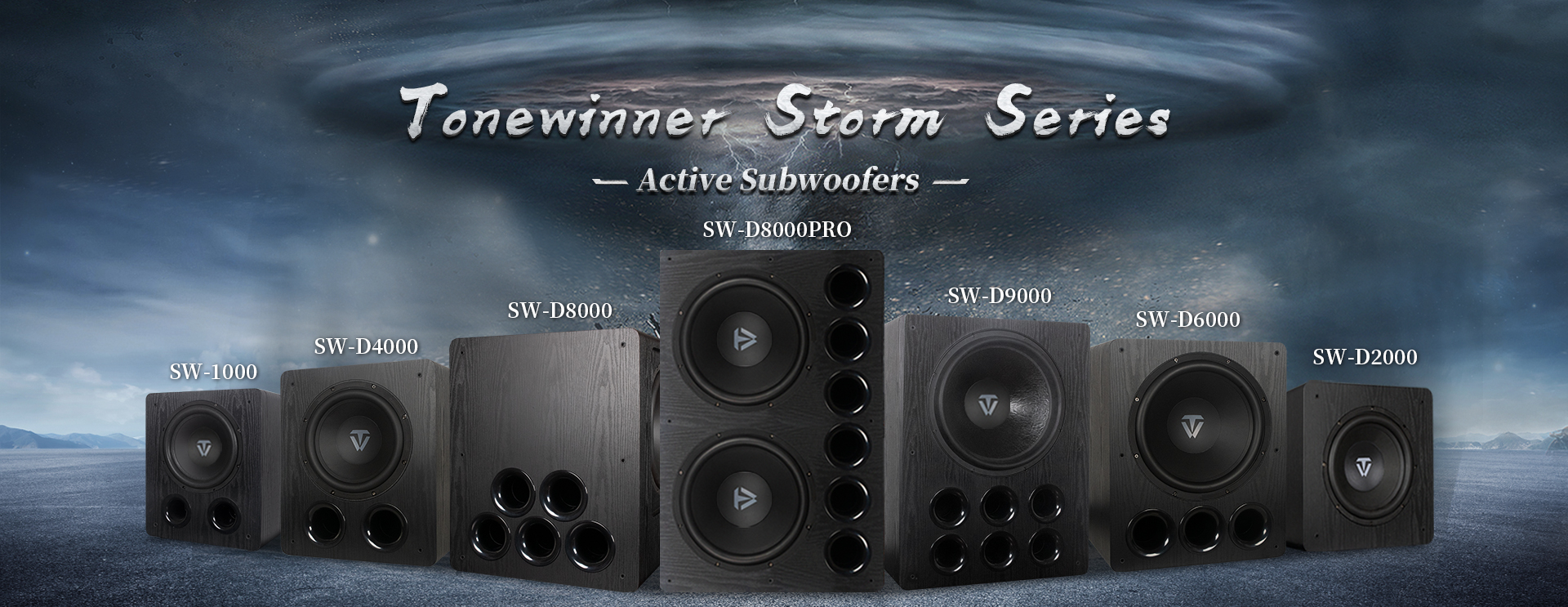
Tonewinner's Storm Series includes multiple active subwoofer models designed for different applications, from compact living rooms to more demanding home theater environments.
For example, the SW-D2000 features a 12-inch driver and 400W RMS amplifier output, while the SW-D4000 offers a 12-inch driver with 800W RMS output and advanced DSP adjustment. The SW-D4000 also includes app control, multiple frequency modes, and seven-band parametric EQ.
These specifications illustrate why choosing a subwoofer should involve more than comparing driver diameter alone. Amplifier capability, enclosure design, frequency response, and the room itself all contribute to the final result.
You can also read Tonewinner's comparison of the SW-1000 and SW-D2000 active subwoofers to understand how different models serve different listening environments.
Why Your AV Processor Matters in a Multi-Subwoofer System
A good subwoofer needs an equally capable signal-processing system. The AV receiver or processor determines how low-frequency signals are routed, how bass management is configured, and what adjustment options are available for integrating multiple subwoofers.
For a basic home theater, one subwoofer output may be sufficient. For more advanced installations, multiple subwoofer outputs can provide greater flexibility, depending on whether the outputs are independently adjustable or simply carry the same signal.
Tonewinner's AT-2900, for example, supports three subwoofer outputs and configurations such as 7.3.6 and 9.3.4. This makes it relevant to enthusiasts planning a more advanced multi-subwoofer Dolby Atmos system.
For users building a complete immersive cinema system, exploring the Tonewinner Dolby Atmos AV receiver range is a useful next step. Always verify the number of independently configurable subwoofer channels for the specific model before purchasing.
What Is the Best Subwoofer Setup for Different Room Sizes?
Room size provides a useful starting point, but it should not be treated as the only factor. The following recommendations are practical planning guidelines rather than fixed engineering specifications.
| Room Type | Suggested Setup | Priority |
|---|---|---|
| Small living room | One subwoofer | Simple integration and balanced bass |
| Medium-sized home theater | One or two subwoofers | Output and seating consistency |
| Large home theater | Two subwoofers | Low-frequency coverage |
| Dedicated multi-row cinema | Two or four subwoofers | Room-wide consistency and headroom |
For open-plan living rooms, irregular layouts, or rooms with large openings, the effective acoustic space may be considerably larger than the floor area suggests. In these situations, subwoofer output capability and placement become particularly important.
One, Two, or Four Subwoofers: What Is Our Recommendation?
For most home theater owners, we recommend starting with one capable subwoofer and upgrading to two when better bass consistency across multiple seats is needed. Four subwoofers are best reserved for larger rooms, dedicated cinema installations, or systems where careful acoustic optimization justifies the additional equipment.
If your room has one main listening position, one properly selected and calibrated subwoofer can already deliver an impressive cinematic experience. If your family regularly watches movies across a large sofa or several rows of seats, two subwoofers are often a more practical investment.
If you are building a dedicated home cinema with multiple seating rows and demanding output requirements, a four-subwoofer arrangement may offer additional flexibility, provided that the AV processor, placement, and calibration support it.
Ultimately, the best home theater subwoofer system is not the one with the most cabinets. It is the one that delivers accurate, powerful, and consistent bass throughout your listening area.
Explore Tonewinner home theater audio products to find subwoofers, AV receivers, and processors for your next home cinema project.
Frequently Asked Questions About Home Theater Subwoofers
How many subwoofers are best for a home theater?
One subwoofer is sufficient for many small and medium-sized home theaters. Two are often better for consistent bass across multiple seats, while four are generally more suitable for large dedicated cinema rooms.
Are two subwoofers better than one?
Two properly positioned and calibrated subwoofers can provide more even bass distribution across a listening area and additional output headroom. However, they are not automatically better if placement and calibration are incorrect.
Do four subwoofers make bass louder?
Four subwoofers can increase available low-frequency output, depending on their design and configuration. Their main advantage in many installations is greater flexibility in managing room acoustics and distributing bass across multiple seating positions.
Can I use two different subwoofer models together?
Yes, but matching subwoofers are generally easier to integrate. Different models may have different frequency responses, output capabilities, and phase characteristics, so careful level, delay, phase, and EQ adjustment is recommended.
Where should I place two home theater subwoofers?
Common starting positions include the front left and right corners, the front and rear center positions, or the middle of opposing side walls. The best arrangement depends on room dimensions and measured bass response.
Does a Dolby Atmos system need more than one subwoofer?
No. Dolby Atmos does not require multiple subwoofers. A 5.1.2 or 7.1.4 system can work with one subwoofer. Additional subwoofers are an option for improving bass coverage and output, not a requirement of the Atmos format.
Does a bigger subwoofer always sound better?
No. Driver size is only one specification. Amplifier power, enclosure design, frequency response, distortion, DSP, room acoustics, and proper integration all affect sound quality.
What is the difference between a 5.1, 5.2, and 5.4 home theater system?
The first number represents the main speaker channels, while the second number indicates the number of subwoofers in the system configuration. Therefore, 5.1 has one subwoofer, 5.2 has two, and 5.4 has four. The actual signal routing and independent control capabilities depend on the AV processor or receiver.
Can one powerful subwoofer replace two smaller subwoofers?
One powerful subwoofer may provide sufficient output for a single listening position, but it cannot always reproduce the same room-wide bass consistency as two properly placed subwoofers. Output capability and bass distribution are two different considerations.
How many subwoofers does the Tonewinner AT-2900 support?
The Tonewinner AT-2900 supports three subwoofer outputs and home theater configurations such as 7.3.6 and 9.3.4. Check its detailed signal routing and configuration options when planning an installation.